
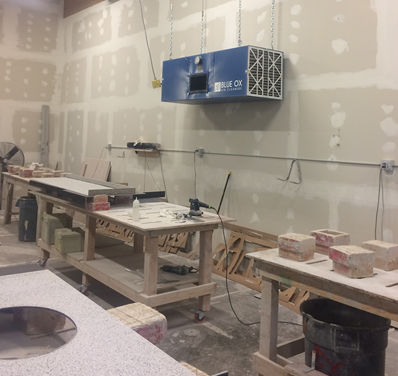
Air Filtration Systems vs. Dust Collectors
Summary
Air filtration systems and dust collectors both remove harmful airborne contaminants from industrial facilities, but they do different jobs. Dust collectors are primary systems that capture high-volume process dust at the source using ducting and centrifugal fans. Air filtration systems are ambient secondary systems that recirculate facility air through filters to catch fine particulate and weld fume that escape primary collection. In welding and fabrication environments, the two work best together. Fume Xtractors carries Blue Ox ambient air filtration systems alongside our own line of source-capture and ambient extraction equipment, giving shops a complete solution for indoor air quality from source to ceiling.
Why Indoor Air Quality Matters in Fabrication Shops
Indoor air quality continues to gain recognition as a critical workplace health issue, and for good reason. In welding and fabrication environments, airborne contaminants include weld fume, metal dust, grinding particulate, VOCs, and smoke from cutting and laser operations. Long-term exposure to these substances is associated with serious respiratory conditions, neurological effects, and in some cases, occupational cancer.
Federal and state regulations, including OSHA's permissible exposure limits (PELs) for hexavalent chromium, manganese, and weld fume, require employers to implement engineering controls to reduce worker exposure. Air filtration and dust collection are two of the primary engineering control strategies recognized by OSHA and ACGIH for meeting those standards.
Beyond regulatory compliance, cleaner air has a direct impact on productivity, equipment lifespan, and employee retention. Shops that invest in proper air quality control consistently report lower absenteeism, reduced equipment maintenance costs, and better overall morale.
Two Approaches to Industrial aIR iMPROVEMENT
There are two main strategies for controlling indoor air contaminants in industrial facilities: source capture and ambient air filtration.
Dust collectors and portable fume extractors are source-capture systems, they remove contaminants at the point of generation before they spread. Ambient air filtration systems recirculate and filter the facility air as a whole, catching what source capture misses.
In practice, these two approaches are complementary. Source capture handles the bulk of contamination load; ambient filtration provides the secondary safety net that keeps overall facility air quality within compliance and comfort thresholds.
How Air Filtration Systems Work
Ambient air filtration systems are installed throughout a facility and continuously recirculate room air through filter media to remove fine particulate, fume, and other contaminants.
Blue Ox systems, available through Fume Xtractors, are offered in two configurations, pass-thru and T-style, each with a different blower and filter layout, but operating on the same three-stage process:
1. Capture
Large centrifugal blowers draw contaminated facility air into the unit and transport it through a series of specialized filters designed to allow airflow while trapping particles.
2. Filtration
Captured particles are filtered out based on the design and efficiency rating of the installed filter media. Blue Ox systems support a range of filter options — including HEPA filters and activated carbon filters, allowing the system to be configured for the specific contaminants present in your facility, whether that's weld fume, fine metal dust, or VOCs and odors.
3. Clean Air Circulation
Filtered air is returned to the facility, preventing stagnant air pockets and maintaining active circulation throughout the workspace. Blue Ox units are installed in a pattern designed to create circular, balanced airflow across the full facility footprint, eliminating dead zones where contaminants can accumulate and reducing strain on existing HVAC systems.
How Dust Collection Systems Work
Dust collectors are primary, source-connected systems designed to handle high volumes of process dust generated during grinding, cutting, machining, and other industrial material processing.
Ducting connects source points directly to the collector, where a centrifugal fan draws contaminated air through filter media.
The two most common collector types are:
Cartridge Collectors
Cartridge collectors use pleated filter cartridges made from spun-bonded polyester, cellulose, or composite materials to capture dust on the filter surface while allowing air to pass through. As filters load with dust, pulse cleaning (a brief burst of compressed air) dislodges the accumulated cake and drops it into a collection hopper, restoring airflow and filter efficiency. Cartridge collectors are well-suited for fine metalworking dust and weld fume with moderate dust loads.
Baghouse Collectors
Baghouse collectors handle higher-volume dust loads using fabric filter bags. Contaminated air passes through the bag material, trapping dust on the fabric surface while clean air exits. Baghouses are common in heavy manufacturing and bulk material handling applications where dust volumes exceed what cartridge systems are designed to manage.
In both cases, filtered air can either be exhausted outside the facility or returned to the workspace, depending on the system configuration and local regulatory requirements.
Using Air Filtration and Dust Collection Together
In welding and fabrication facilities where both process dust and weld fume are present, using air filtration as a secondary system alongside dust collection provides the most comprehensive contamination control.
Dust collectors handle the primary dust load at the source; ambient air filtration captures the fine respirable particles and fume that escape into the general facility air.
This dual-layer approach is especially important in facilities where:
- Multiple welders are working simultaneously in an open bay
- Grinding and cutting generate fine particles that bypass source-capture hoods
- Regulations require general dilution ventilation in addition to local exhaust
- HVAC systems are not designed to handle industrial-grade airborne contaminants
Fume Xtractors carries both Blue Ox ambient air filtration systems and our own line of portable source-capture fume extractors, giving shops the ability to build a complete, layered air quality strategy from a single vendor.
Benefits of Air Filtration Systems & Dust Collectors
Improved Worker Health and Productivity
Cleaner indoor air is directly linked to reduced respiratory illness, fewer sick days, and measurably better cognitive performance. Employees working in facilities with controlled air quality report higher focus, energy, and job satisfaction — and lower rates of long-term occupational disease.
Equipment and Surface Protection
Airborne particulate that isn't captured eventually settles on machinery, control panels, flooring, and finished workpieces. Active air filtration and dust collection prevent this accumulation, reducing equipment wear, lowering maintenance costs, and protecting product quality — especially in precision fabrication environments.
Regulatory Compliance
OSHA's General Industry standards for welding (29 CFR 1910.252) and airborne contaminants (29 CFR 1910.1000) require engineering controls as the first line of defense against overexposure. Air filtration systems and dust collectors are recognized engineering controls that help facilities document and maintain compliance with PELs for weld fume, hexavalent chromium, manganese, and metal dust.
Energy Efficiency and HVAC Load Reduction
When industrial contaminants enter general HVAC systems, filters clog prematurely and equipment runs harder to maintain air circulation. Dedicated air filtration systems — particularly Blue Ox units designed for balanced circular airflow — intercept contaminants before they reach HVAC infrastructure, extending filter life and reducing energy consumption across the facility.
Customizable Filter Options
Blue Ox air filtration systems are available with a range of filter media, standard particulate, HEPA, and activated carbon, so facilities can configure their system to the specific mix of fume, dust, and VOCs present in their environment. Fume Xtractors can help identify the right configuration for your application.
FAQs: Air Filtration vs. Dust Collection
What is the difference between an air filtration system and a dust collector?
Dust collectors are primary systems designed to capture high volumes of process dust at the source using ducting and centrifugal fans.
Air filtration systems are ambient secondary systems that circulate and filter the air remaining in the facility after dust collection, catching fine airborne particles that escape the primary system. In welding and fabrication environments, both are often used together for comprehensive fume and dust control.
Do I need both a dust collector and an air filtration system?
In most industrial fabrication and welding environments, yes. Dust collectors handle the bulk of process dust at the source, but fine particulate and weld fume can escape into the ambient air.
An air filtration system acts as a secondary layer, recirculating facility air through filters to capture what the dust collector misses. This dual approach provides broader contaminant control and helps meet OSHA air quality standards.
How does an ambient air filtration system work?
Ambient air filtration systems use large centrifugal blowers to draw contaminated facility air through a series of filters. Particulate is trapped in the filter media while clean air is returned to the workspace.
Blue Ox systems, available through Fume Xtractors, are installed in a pattern that creates circular, balanced airflow throughout the facility to eliminate stagnant air pockets and prevent HVAC overload.
What types of dust collectors are available?
The two most common industrial dust collector types are cartridge collectors and baghouse collectors. Cartridge collectors use pleated filter media to capture dust on the filter surface, with pulse cleaning to restore efficiency over time.
Baghouse collectors handle higher dust volumes using fabric bags as filter media. The right choice depends on the volume of dust generated, particle size, and specific application requirements.
What filter options are available for air filtration systems?
Blue Ox air filtration systems, available through Fume Xtractors, offer standard particulate filters, HEPA filters for fine particle capture, and activated carbon filters for odor and VOC control. Filter selection depends on the specific contaminants present in your facility.
Can an air filtration system replace a dust collector?
No. Air filtration systems are designed as ambient secondary systems and are not engineered to handle the high-volume dust loads that a dedicated dust collector manages at the source.
In facilities with significant dust generation from grinding, cutting, or machining, a dust collector should be the primary control, with an air filtration system providing secondary ambient coverage.
What is the benefit of circular airflow in ambient air filtration?
Circular, balanced airflow, created by the strategic installation pattern of Blue Ox air filtration systems, prevents stagnant air pockets from forming in corners, near the ceiling, or in low-traffic areas of a facility.
Stagnant zones allow fine particulate and fume to accumulate uncaptured. Balanced airflow also reduces strain on HVAC systems, improving overall energy efficiency.
You may also like:
• Debunking Common Misconceptions About Fume Extraction
• NFPA 660 Updates: Welding & Grinding On Explosive Dusts
• Understanding Combustible Dust Hazards in Welding Environments